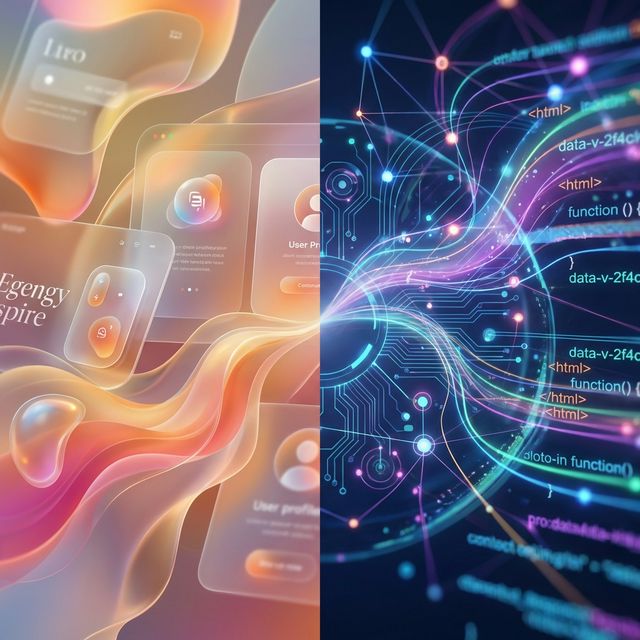
"In 2026, a website is no longer just a digital brochure; it is an intelligent, breathing organism that adapts to the user in real-time."
For years, web design has followed predictable cycles of flat design, minimalism, and brutalism, while developers chased incrementally faster build tools. But as we step firmly into 2026, the paradigm has shifted permanently. The convergence of generative AI, WebGL performance leaps, and the absolute necessity of Answer Engine Optimization (AEO) have rewritten the rules.
Today, building a high-performance website requires an intricate dance between radical, human-centric aesthetics on the frontend and machine-readable, AI-optimized architecture on the backend. This is the ultimate, 2500-word guide to navigating the web design and development trends dominating 2026. If you are an agency owner, a CMO, or a brand director looking to overhaul your digital presence, this is your blueprint.
1Development: The AI-First Meta-Framework Era
The role of the web developer has evolved from "code writer" to "systems architect." In 2026, starting a project with plain HTML/CSS or a clunky legacy CMS is professional negligence. We have fully entered the era of the AI-First workflow and the Meta-Framework standard.
The 2026 Tech Stack Standard:
React & Next.js
Next.js is no longer just "nice to have"; it is the default operating system for the professional web. Features like React Server Components (RSC) and built-in image/font optimization are critical for passing Core Web Vitals while maintaining complex, interactive UIs.
AI Scaffolding
Developers now use AI co-pilots not just to autocomplete code, but to generate entire architectural wireframes, automated testing suites, and database schemas instantly. This shifts the agency's focus from typing boilerplate to optimizing business logic and user experience.
Headless CMS
The frontend (how it looks) is completely decoupled from the backend (where the content lives). This API-first approach allows content to be pushed simultaneously to a web app, a mobile app, and even a smartwatch, instantly.
Edge Computing
Websites are no longer hosted on a single server in Virginia. Code execution happens at the "edge"—meaning the data is processed on a server mere miles away from the user, reducing latency to near zero.
2Architecture: Semantic HTML as "SEO 2.0"
As we outlined in our Ultimate Guide to GEO, search has fundamentally changed. Users are increasingly getting their answers directly from AI Overviews (AIOs) or tools like ChatGPT, rather than clicking through ten blue links.
To survive, your website's architecture must be perfectly legible to Large Language Models (LLMs). This is the practice of Answer Engine Optimization (AEO). LLMs don't care how pretty your site is; they care about how logically your code is structured.
The Return of Strict Semantic HTML
In the early days of React, developers became lazy, wrapping everything in meaningless <div> tags. In 2026, this destroys your AI search visibility.
- Bad:
<div class="article-title">...</div> - Good:
<h1 itemProp="headline">...</h1> - Good:
<article itemScope itemType="...">...</article>
Furthermore, Structured Data (Schema Markup) has graduated from basic business info to detailed "Knowledge Graphs." You must use nested JSON-LD to explicitly explain the relationships between your authors, your services, your reviews, and your case studies. You aren't just building a webpage; you are building a database API for Google's AI to consume.
3UX: Hyper-Personalized, Role-Based Journeys
The era of the generic "one-size-fits-all" homepage is over. In a privacy-first world where third-party cookies are dead, high-end websites use zero-party data and on-site behavioral signals to reshape themselves in real-time.
Dynamic UI Morphing
Imagine a B2B SaaS website. If the user arrives via an organic search for "enterprise API integration," the hero section instantly morphs to highlight technical documentation and developer tools.
If they arrive via a LinkedIn ad targeting CFOs, the same URL loads an interface emphasizing ROI calculators, compliance certifications, and executive summaries.
Personalization Vectors 2026:
- →Industry Specificity: Swapping out case studies dynamically.
- →Buying Stage: Returning visitors see "Book Demo" instead of "Read Ebook."
- →Dark/Light Mode Sync: Respecting the user's OS-level visual preferences automatically.
4Design: The Organic Visual Renaissance
As backend technology becomes more rigid and machine-focused, frontend design is rebelling by becoming intensely human, organic, and soft. We are stepping away from the cold, sharp grids of the early 2020s.
Glassmorphism & Soft UI
Interfaces are utilizing translucent backgrounds, subtle blurs, and floating cards to create a sense of depth and hierarchy without harsh borders. It mimics physical glass, making the digital space feel tactile.
Organic Gradients & Shapes
Flat colors are being replaced by complex, warm, breathing gradients that shift slowly as the user scrolls. Sharp 90-degree boxes are giving way to "blob" shapes and asymmetrical anti-grid layouts that guide the eye naturally.
Kinetic Typography
Text is no longer static. Oversized, expressive serif fonts animate on scroll—stretching, compressing, or revealing themselves letter-by-letter. Typography has become the primary design element, replacing generic stock photography.
Micro-Interactions
Every click, hover, and scroll provides immediate, satisfying physical feedback. A button might subtly depress; a cursor might invert the color of the text beneath it. These details elevate a site from "usable" to "premium."
5. Performance: Speed as a Conversion Metric
You can have the most personalized, visually stunning website on the internet, but if it takes more than 1.5 seconds to become interactive, you have failed. In 2026, performance isn't a technical detail; it is the ultimate measure of user respect and the heaviest ranking factor.
Google's Core Web Vitals (CWV)—specifically Largest Contentful Paint (LCP) and Interaction to Next Paint (INP)—are strictly enforced benchmarks. Modern users, conditioned by the instant load times of native apps like TikTok and Instagram, will bounce immediately if confronted by a loading spinner.
The 2026 Performance Requirements:
< 2.5s
Largest Contentful Paint (LCP)The time it takes for the largest image or text block to render. Achieved via priority loading and aggressive image optimization (AVIF/WebP formats).
< 200ms
Interaction to Next Paint (INP)The time it takes for the site to visually react after a user clicks or taps. Achieved by offloading heavy JavaScript execution to web workers and minimizing main-thread blocking.
0.0
Cumulative Layout Shift (CLS)The page must not jump around as assets load. Achieved by pre-defining aspect ratios for all media and avoiding dynamic ad insertions above the fold.
Conclusion: Choosing the Right 2026 Agency Partner
A website rebuild in 2026 is a complex orchestration of visual design, rigorous backend engineering, and AI-centric SEO strategy.
You can no longer hire a traditional "web designer" who throws together a WordPress theme and expects it to perform. You need a multidisciplinary team. You need developers who understand React and Edge execution. You need designers who understand kinetic typography and glassmorphism. And you need strategists who know how to map your semantic entities for AI search engines.
Is Your Website Ready
for the AI Era?
Don't let legacy code and outdated design hold back your growth. Partner with Coko Agency to build a high-performance, hyper-personalized, AEO-ready digital experience.